Char Dham Yatra with Family — What to Pack, What to Expect
Kids in tow, elderly parents beside you, a tiffin box in the back seat, and four of India’s most sacred shrines ahead — this is how the most meaningful pilgrimages unfold. Here is everything your family needs to know before you go.
Is Char Dham Realistic with a Family? Honest Answer
Yes — but only if you go in with clear eyes. Char Dham Yatra covers roughly 1,000 km of Himalayan terrain, touching altitudes from 2,700 m at Yamunotri to over 3,500 m at Kedarnath. The roads wind, the queues at temples can stretch for hours, and the weather in the high Himalayas turns without warning.
That said, hundreds of thousands of Indian families complete the circuit every season — infants on grandmothers’ laps, school-age children asking relentless questions at every dhaba, teenagers grudgingly discovering the scale of the Himalayas. The journey is hard by design; that hardship is also its gift. With proper preparation, families not only manage Char Dham — they are transformed by it.
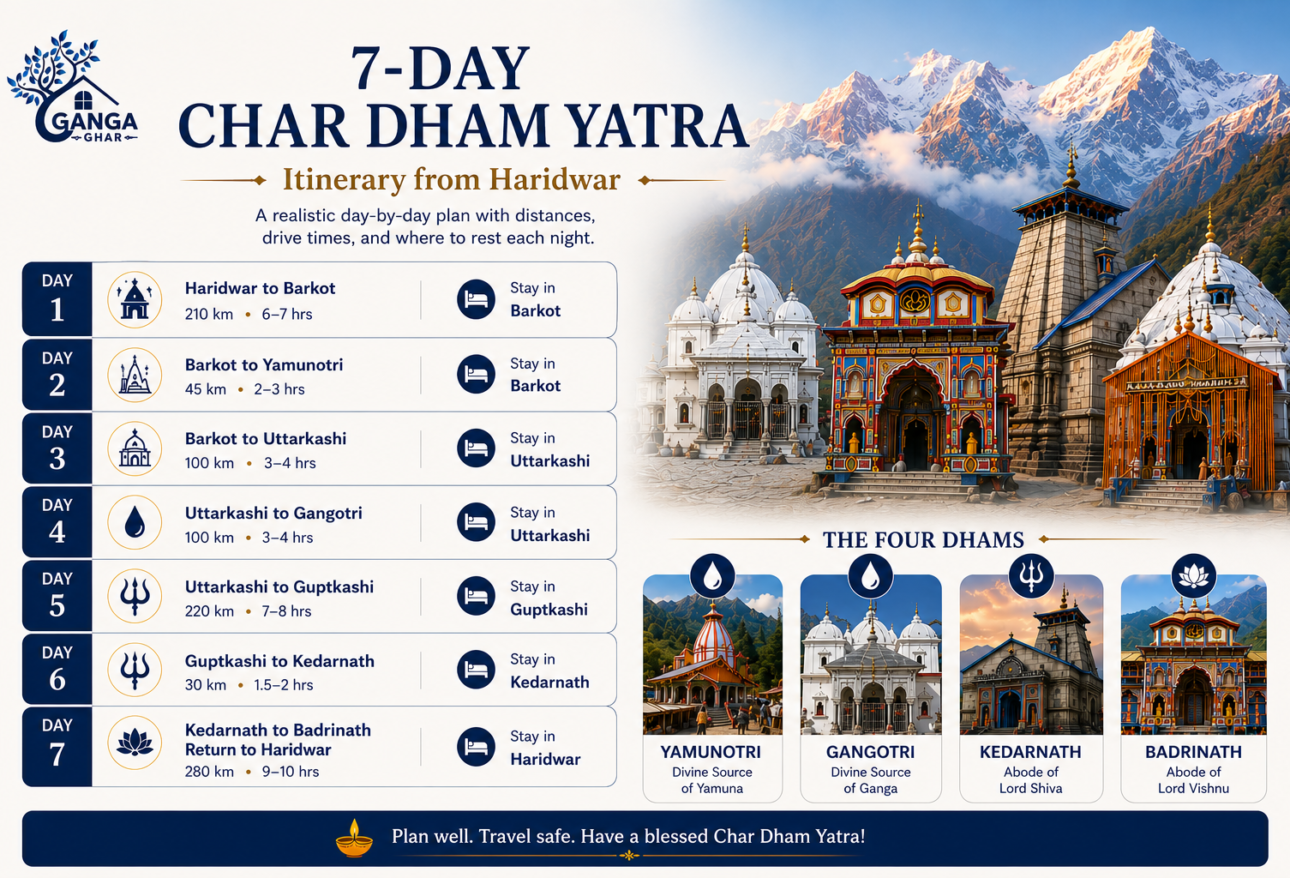
The single most important decision is your pace. A rushed 6-day itinerary that works for a fit couple will exhaust a family with children or elderly members. Budget at least 8 days on the circuit itself, plus an arrival and departure day in Haridwar on each end. Read our full 7-day Char Dham itinerary as a baseline and add one rest day wherever you feel altitude may be an issue.
Best months for families: May (pre-monsoon), and September–October (post-monsoon). Avoid June–August unless weather disruption is something your family can absorb gracefully.
Age-Suitability: Toddlers, School-Age, Teens & Elderly Parents
Every age group can do Char Dham — but each comes with its own considerations.
Toddlers and young children (under 6)
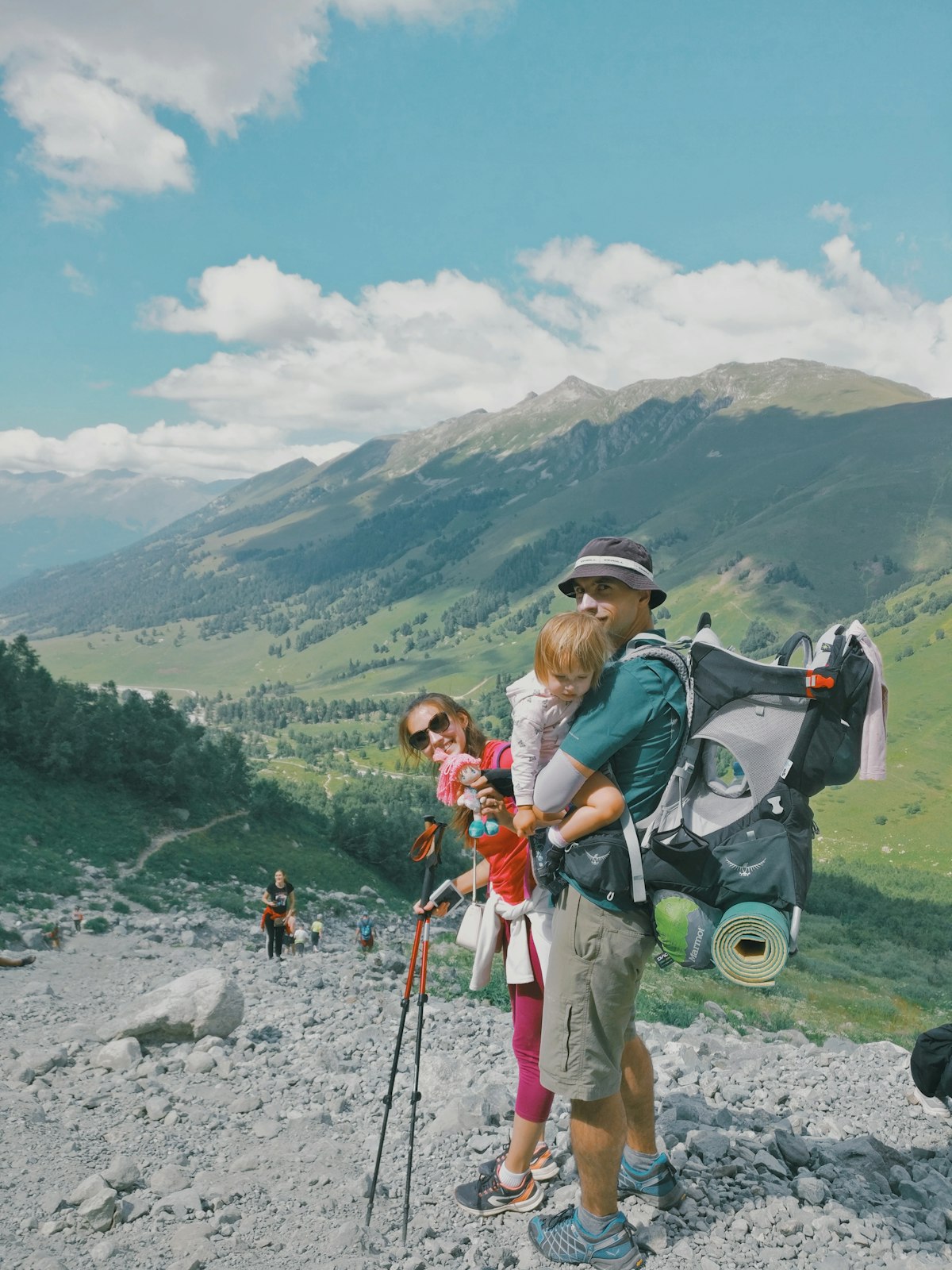
The high altitude and cold nights at Kedarnath are the main concerns. Keep very young children at base camps like Sonprayag or Gaurikund rather than carrying them up to Kedarnath Temple if they show any sign of breathlessness. Yamunotri and Gangotri are generally fine for toddlers. Carry a child carrier or sling — strollers are useless on stone paths.
School-age children (6–14)
This is arguably the best age for the yatra. Children in this range are old enough to understand the significance of what they’re seeing, hardy enough for the physical demands, and young enough to find the entire adventure genuinely exciting. The pony and palki rides at Yamunotri and Kedarnath become highlights they will talk about for years.
Teenagers
Teenagers sometimes resist the spiritual framing, but the sheer scale of the Himalayas rarely fails to impress. Assign them a role — tracking the route on a map, photographing the journey, carrying a shared pack — and they tend to step up. The trek to Kedarnath, in particular, often becomes a point of pride.
Elderly parents (60+)
Pre-yatra medical checks are non-negotiable — blood pressure, cardiac clearance, and a conversation with your doctor about altitude. Palkis (palanquins) are available at Yamunotri and Kedarnath, as are ponies. Helicopters to Kedarnath are bookable in advance and are a genuinely sensible choice for seniors. Build in longer rest stops and do not rush darshan timings to “save time.”
Packing Checklist — Kids, Parents & Medicines

A family pack list for Char Dham is different from a solo traveller’s. You are carrying for multiple temperature zones, multiple body sizes, and a medicine cabinet that no chemist at altitude will fully stock.
Clothing
- Thermal base layers for each family member (including children)
- Fleece mid-layer and a windproof outer jacket — temperatures drop sharply at night even in May
- Waterproof rain poncho for each person; monsoon-edge weather is unpredictable
- Comfortable walking shoes with ankle support; rubber-soled sandals for temple courtyards
- Woollen socks × 3 pairs per person; thin cotton socks for temple entries
- A warm hat or woollen cap for children and elderly members
Essentials
- High-SPF sunscreen (UV intensity at altitude is severe)
- Lip balm, moisturiser — cold Himalayan air is extremely drying
- Reusable water bottles (minimum 1 litre per person)
- Headlamps for early morning starts at temples
- Snack supply: dry fruit, nuts, chikki, glucose biscuits for children
- Extra plastic bags for wet clothes and temple footwear
Medicine Kit
- Diamox (Acetazolamide) — for altitude acclimatisation; consult your doctor on dosage for children and seniors
- ORS sachets (indispensable at altitude and after the trek)
- Paracetamol and ibuprofen for fever and headaches
- Motion sickness tablets (Avomine or equivalent) — the mountain roads are relentless
- Antacids and digestive tablets — diet changes and altitude affect digestion
- Basic wound care: antiseptic, bandages, a blister kit
- Any prescription medications in sufficient supply for the full trip plus 3 extra days
- A pulse oximeter — invaluable for monitoring everyone’s oxygen saturation at altitude
Tip: Pack medicines in a dedicated pouch that stays in the vehicle, not buried in a checked bag. You will need them mid-journey, not at the end.
Food & Water on the Route
Families travelling with children or elderly members often worry about food quality on the circuit. The good news: Char Dham is one of the most vegetarian-friendly routes in India. Every dham has established dhabas and community kitchens (langars) serving freshly cooked satvik food — no onion, no garlic, no meat. Jain-friendly options (no root vegetables) are less consistent but available at larger establishments if you ask in advance.
Water
Drink only filtered or boiled water throughout the circuit. Despite the pristine appearance of mountain streams, waterborne illness is a genuine risk. Most major dhabas and hotels provide boiled water or sell sealed mineral water. Carry your own filled bottles from your accommodation each morning rather than relying on availability at altitude.
Family Tiffin Tips
Pack a tiffin box from your accommodation for long driving days — this is especially useful on the Haridwar to Barkot stretch (Yamunotri) and the Uttarkashi to Gangotri road, where stretches of 60–90 km pass through small villages with limited options. Simple khichdi, parathas with pickle, or plain rice and dal travel well and are safe for children and elderly members. Most guesthouses along the route will pack food on request if you book ahead.
Temples with Kids — Etiquette & Darshan Flow
Indian temples during pilgrimage season are extraordinary — and chaotic. Going in with realistic expectations about queue lengths and crowd density makes the experience manageable for a family.
Queue management
At all four dhams, VIP darshan passes are available for purchase and significantly reduce waiting time. For families with young children or elderly members, this is money well spent. Aim to reach temples before 7 am for the shortest queues and the most serene atmosphere. The 9 am–12 pm window is invariably the busiest.
Child etiquette at sacred sites
Brief children before entering that bare feet are required in temple premises, that loud play is not appropriate, and that touching temple idols or sacred lamps is not allowed. Most children respond well to being told why — the historical and mythological context of each dham is genuinely fascinating to a curious 8-year-old. Our individual guides to Yamunotri, Gangotri, and Badrinath have the stories worth telling your children en route.
After darshan
Budget 30 minutes after darshan for the family to collect themselves, drink warm chai, and let younger children rest. The post-darshan rush to get back to the vehicle is where accidents and separations happen. Designate a fixed meeting point near the temple exit before entering, especially if the group will split across different queue lines.
Safety, Altitude, Motion Sickness & Breaks
The two biggest safety concerns for families on Char Dham are altitude sickness and motion sickness. Both are preventable with preparation.
Altitude sickness
Acute Mountain Sickness (AMS) can affect anyone above 2,500 m, regardless of fitness level. Symptoms — headache, nausea, dizziness, fatigue — are the body’s signal to stop ascending, not to push harder. The protocol is simple: if anyone in the family shows symptoms, rest at that altitude for 24 hours before continuing. Descend immediately if symptoms worsen. Keep a pulse oximeter with you; an SpO2 reading below 90% at altitude warrants immediate descent.
Children and elderly members are not necessarily more susceptible to AMS than healthy adults, but they are often less able to articulate what they are feeling. Check in with them regularly and watch for unusual quietness, loss of appetite, or irritability — all potential early AMS signals.
Motion sickness
The road from Rishikesh to Barkot, the descent from Jankichatti, the switchbacks above Uttarkashi — motion sickness is near-universal among families on these roads if they haven’t medicated. Give motion sickness tablets at least 45 minutes before the journey begins. Sit children in front if possible. Stop every 90 minutes regardless of how people feel — fresh air and a short walk reset the body significantly. Avoid heavy meals immediately before long mountain drives.
General road safety
Book a driver with Himalayan road experience rather than self-driving, especially for the Rudraprayag–Gaurikund stretch and the Badrinath highway. These are beautiful but technically demanding roads. Early starts (by 6 am) beat both traffic and the afternoon risk of loose stones after sun warms the rock faces. Check the 2026 Char Dham conditions update before departure for any road advisories.
Sample 8-Day Family-Paced Itinerary
| Day | Destination | Key Activity |
|---|---|---|
| Day 1 | Arrive Haridwar | Rest, Ganga Aarti at Har Ki Pauri, early night |
| Day 2 | Haridwar → Barkot | Drive (7–8 hrs); check in, acclimatise |
| Day 3 | Barkot → Yamunotri → Barkot | Trek/pony to Yamunotri Temple; darshan; return |
| Day 4 | Barkot → Uttarkashi | Drive (4 hrs); acclimatise; rest day |
| Day 5 | Uttarkashi → Gangotri → Uttarkashi | Drive to Gangotri; darshan; return |
| Day 6 | Uttarkashi → Kedarnath Base (Sonprayag) | Drive (7 hrs); overnight at base camp |
| Day 7 | Kedarnath Temple | Trek or helicopter to Kedarnath; darshan; return to Sonprayag |
| Day 8 | Sonprayag → Badrinath | Drive via Joshimath (6–7 hrs); darshan at Badrinath |
| Day 9 | Badrinath → Haridwar | Long drive back (9–10 hrs); evening in Haridwar |
This itinerary includes one deliberate rest and acclimatisation day in Uttarkashi — the single most common upgrade families make after completing the yatra. Do not sacrifice it. See the full route and logistics in our complete Char Dham guide.
Why Start and End at Ganga Harmony, Haridwar
Every Char Dham yatra begins and ends in Haridwar — the gateway to the four dhams and the city where the Ganga descends from the mountains into the plains. How you spend your first and last nights here matters more than most families realise.
A pre-yatra night at Ganga Harmony gives your family time to settle after the long journey from your home city, collect provisions, and experience the Ganga Aarti at Har Ki Pauri — an orientation to the sacred atmosphere you will carry through the entire circuit. The post-yatra night is equally important: it is a moment to decompress, bathe in the Ganga, and process what your family has just experienced together.
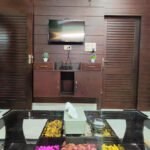
Our 3BHK family suite is designed for exactly this. It comfortably accommodates two generations under one roof — grandparents, parents, and children — with private space for everyone to rest properly. You are walking distance from Har Ki Pauri, away from the noise of the main bazaar, and minutes from where your vehicle to the dhams will depart.
Families who attempt the yatra fatigued from cramped accommodation on Day 1 invariably struggle more on the mountain roads. Starting rested and returning to a calm, spacious home makes the entire journey smoother — for the grandparents who need the comfort and the children who need the space to run.
Book Your Family’s Haridwar Base
Ganga Harmony’s 3BHK suite is the natural start and end point for families doing Char Dham from Haridwar — spacious, central, and a short walk from the Ganga. Availability fills early in the May and October windows.
Check Availability for Your Dates|| Jai Char Dham ||