
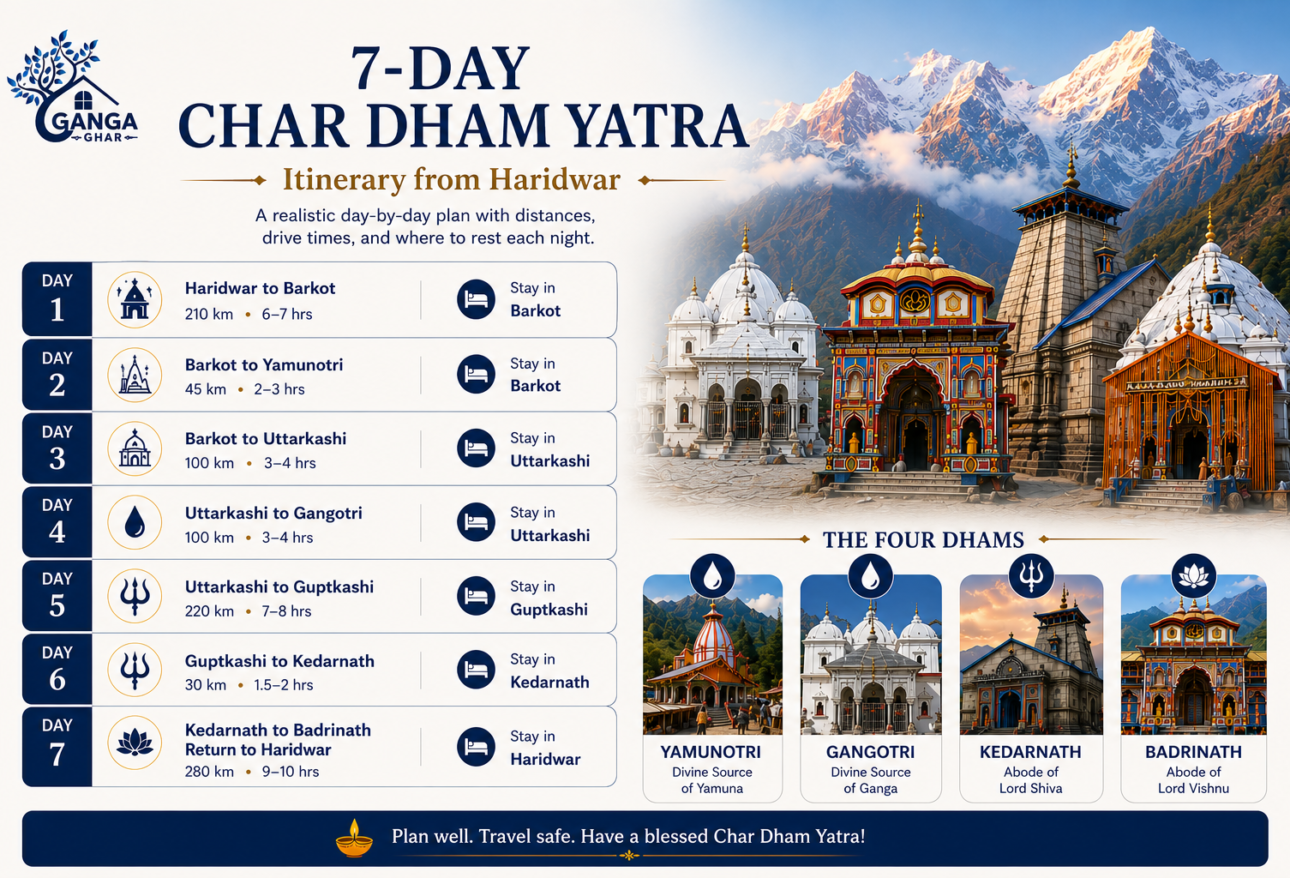
7-Day Char Dham Yatra Itinerary from Haridwar
If you are planning the Char Dham Yatra from Haridwar, the first question is always the same: how many days do I really need? Travel agents will quote anything from five to fourteen. The honest answer is that seven days is the realistic minimum if you want to visit all four dhams without skipping darshan, exhausting elderly travellers, or driving through Himalayan switchbacks after dark. This itinerary is built around that seven-day window, with Ganga Harmony in Haridwar as your launch pad and your decompression stop.
Why 7 days is the realistic minimum
The four dhams — Yamunotri, Gangotri, Kedarnath, and Badrinath — are spread across three Garhwal valleys at altitudes between 3,000 and 3,600 metres. Even taking the traditional clockwise route, the round trip from Haridwar is roughly 1,600 kilometres on mountain roads where average speeds rarely cross 30 km/h. A 5-day yatra exists on paper, but in practice it means leaving Yamunotri darshan at 4 a.m. or skipping Mana village. A 10-day yatra is gentler but adds two transit days. Seven days hits the sweet spot: one dham per “block”, buffer for weather, and a final overnight back in Haridwar before your flight home.
Before we get into the day-by-day plan, a quick orientation. Yatra registration is mandatory for all four dhams — handled online through the Uttarakhand Tourism portal, with a biometric checkpoint at the Rishikesh transit office. If you are travelling with elderly parents, consider helicopter shuttles for Kedarnath at minimum; we cover that on Day 5. And do not underestimate Haridwar itself: the Ganga Aarti at Har Ki Pauri on the evening of your arrival sets the emotional tone for everything that follows.
Day 0: Arrive Haridwar — rest, register, attend the Ganga Aarti
Most pilgrims fly into Dehradun (Jolly Grant) or take the overnight train into Haridwar Junction. Either way, your “Day 0” should be a soft landing day at Ganga Harmony. Drop your bags, eat a proper satvik thali, and confirm your yatra registration QR codes are saved offline. By 5:30 p.m., walk down to Har Ki Pauri for the evening Ganga Aarti — even seasoned travellers find this the most moving introduction to the journey ahead.
If you arrive by lunch, you have time for a short orientation drive through the city’s older temple lanes. The Haridwar tourism guide covers the temples worth squeezing in. Otherwise, save sightseeing for Day 7 when you return.
Day 1: Haridwar → Barkot (210 km, ~7 hours)
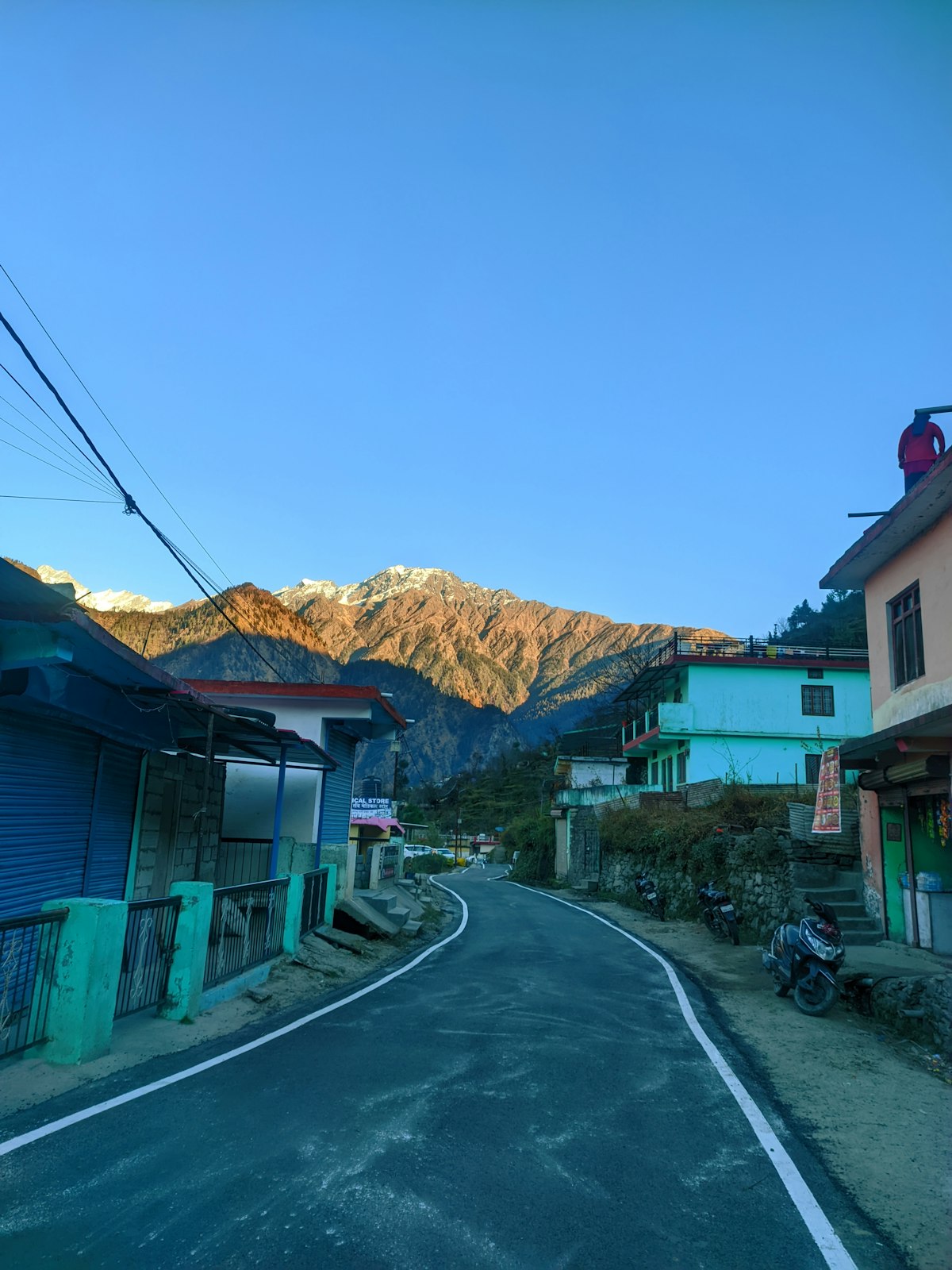
Leave Ganga Harmony by 5:30 a.m. for the long climb to Barkot, the staging town for Yamunotri. The route runs via Dehradun and Mussoorie, then drops over the Radi Pass into the Yamuna valley. Pack motion-sickness tablets — there are roughly 400 hairpin turns between Mussoorie and Barkot. Plan a breakfast halt at Dehradun and a tea stop at Kempty Falls. You will reach Barkot by mid-afternoon, leaving the evening for rest, light dinner, and an early sleep.
Barkot itself is a small town with limited hotel options, but it is the correct stop because Janki Chatti — the trailhead for Yamunotri — is only another 45 km away. Sleeping closer to the trailhead means you can start the Day 2 trek at first light.
Day 2: Yamunotri darshan → Uttarkashi (150 km combined)
Drive from Barkot to Janki Chatti before sunrise. From there, it is a 6-km trek (or pony / palki ride) up to the Yamunotri temple at 3,293 m. Bathe in the Surya Kund hot spring, cook rice in the boiling water as offering, complete darshan, and trek back to Janki Chatti by early afternoon.
After lunch, drive onward — not back to Barkot — toward Uttarkashi via the Yamuna–Bhagirathi divide. The drive is roughly 100 km and takes four hours. Sleeping in Uttarkashi shaves an entire morning off Day 3 and gets you to Gangotri before the afternoon crowds.
Day 3: Uttarkashi → Gangotri darshan → return Uttarkashi (200 km round trip)
Gangotri sits 100 km up the Bhagirathi valley from Uttarkashi at 3,100 m. Leave by 6 a.m., reach Gangotri by 10 a.m., complete darshan, and return by sundown. The Gangotri yatra blog covers the ritual sequence — Bhagirathi snan, Gauri Kund, Pandava Gufa, and the main temple — in detail. Do not attempt the further trek to Gaumukh on a 7-day itinerary; that is a separate three-day expedition.
Returning to Uttarkashi for the night, rather than pushing on toward Guptkashi, is the kindest choice for elderly travellers after a long day at altitude. Eat early, hydrate, and pack for the most demanding transit day of the trip.
Day 4: Uttarkashi → Guptkashi (220 km, ~9 hours)
This is the toughest driving day of the itinerary. The route runs via Moolgarh, Tilwara, and Rudraprayag, crossing the watershed from the Bhagirathi system into the Mandakini valley. There is no shortcut. Start at 5 a.m., plan two halts (Tehri viewpoint and Rudraprayag confluence), and accept that you will reach Guptkashi by late afternoon. Use the evening to rest your back, hydrate, and confirm your Kedarnath plan for the next day — helicopter or trek.
Guptkashi sits at a comfortable 1,300 m, which is helpful for acclimatisation before the climb to Kedarnath. If you have the budget, book a helicopter shuttle from Phata or Sersi for Day 5; tickets must be reserved weeks in advance through the IRCTC heliyatra portal.
Day 5: Guptkashi → Kedarnath → Guptkashi (helicopter or 16-km trek)
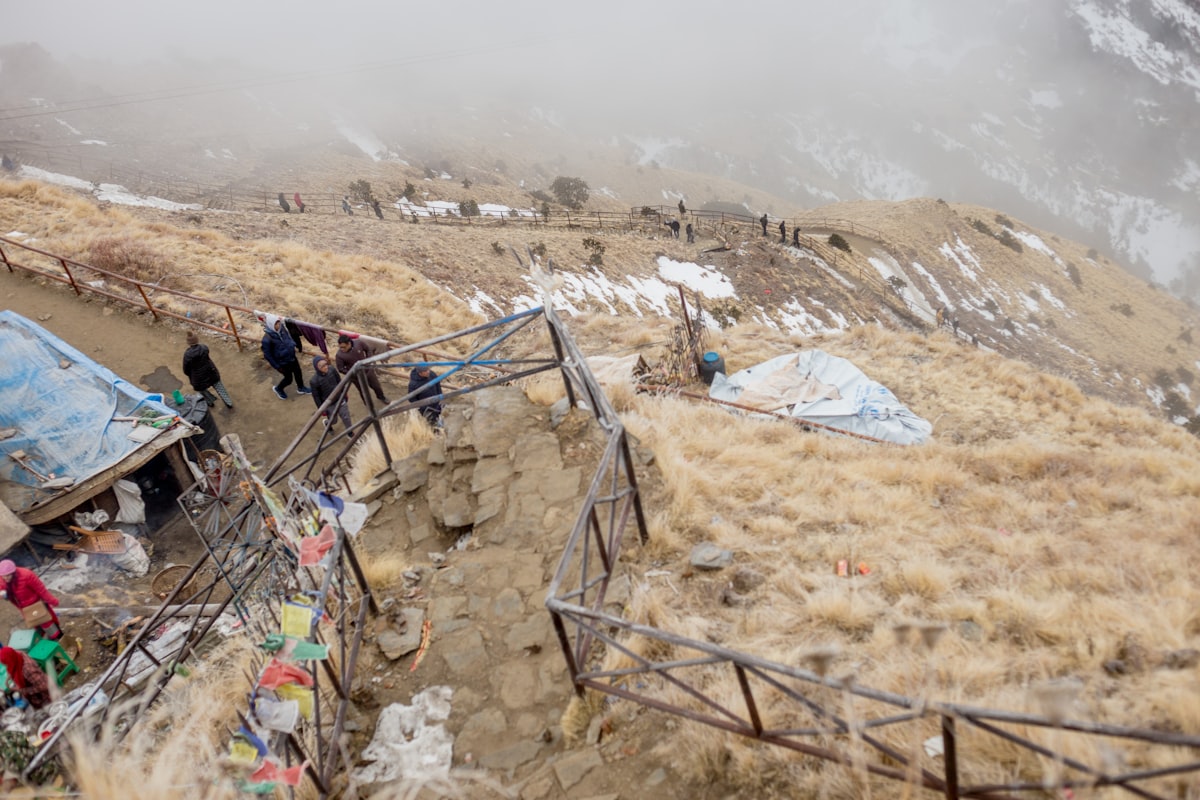
Kedarnath at 3,583 m is the highest of the four dhams and the only one requiring a serious trek (or helicopter shuttle). The helicopter option from Phata, Sersi, or Guptkashi gets you to Kedarnath in eight minutes, allowing for darshan and return by lunchtime. The trek option from Gaurikund is 16 km of steady climb, taking 6–8 hours one way; pilgrims who choose to trek typically stay overnight at Kedarnath in a GMVN cottage and return on Day 6, which extends the itinerary.
For a true 7-day plan, the helicopter is the sensible choice. After darshan, return to Guptkashi by mid-afternoon. The shrine itself is breathtaking — set against the snow walls of Kedar Dome with the Mandakini emerging from the glacier just behind. Do not rush. Plan to spend at least 90 minutes inside the temple complex.
Day 6: Guptkashi → Badrinath → Mana village (190 km, ~7 hours)
From Guptkashi, drive northeast via Chopta and Joshimath to Badrinath. The route climbs to Helang and then descends sharply into the Alaknanda valley before the final climb to Badrinath at 3,300 m. Reach by mid-afternoon, complete darshan at the Badrinath temple, bathe in the Tapt Kund hot spring, and then drive the extra 3 km to Mana village — the last Indian village before the Tibetan border.
Mana is a small, slate-roofed Bhotia village built around the Saraswati River. Vyas Gufa, where the Mahabharata was reputedly dictated, sits at the village edge; the Bhim Pul natural stone bridge is a five-minute walk further. Spend the night in Badrinath itself — Mana has no public lodging.
Day 7: Badrinath → Rudraprayag → Haridwar (320 km, ~10 hours)
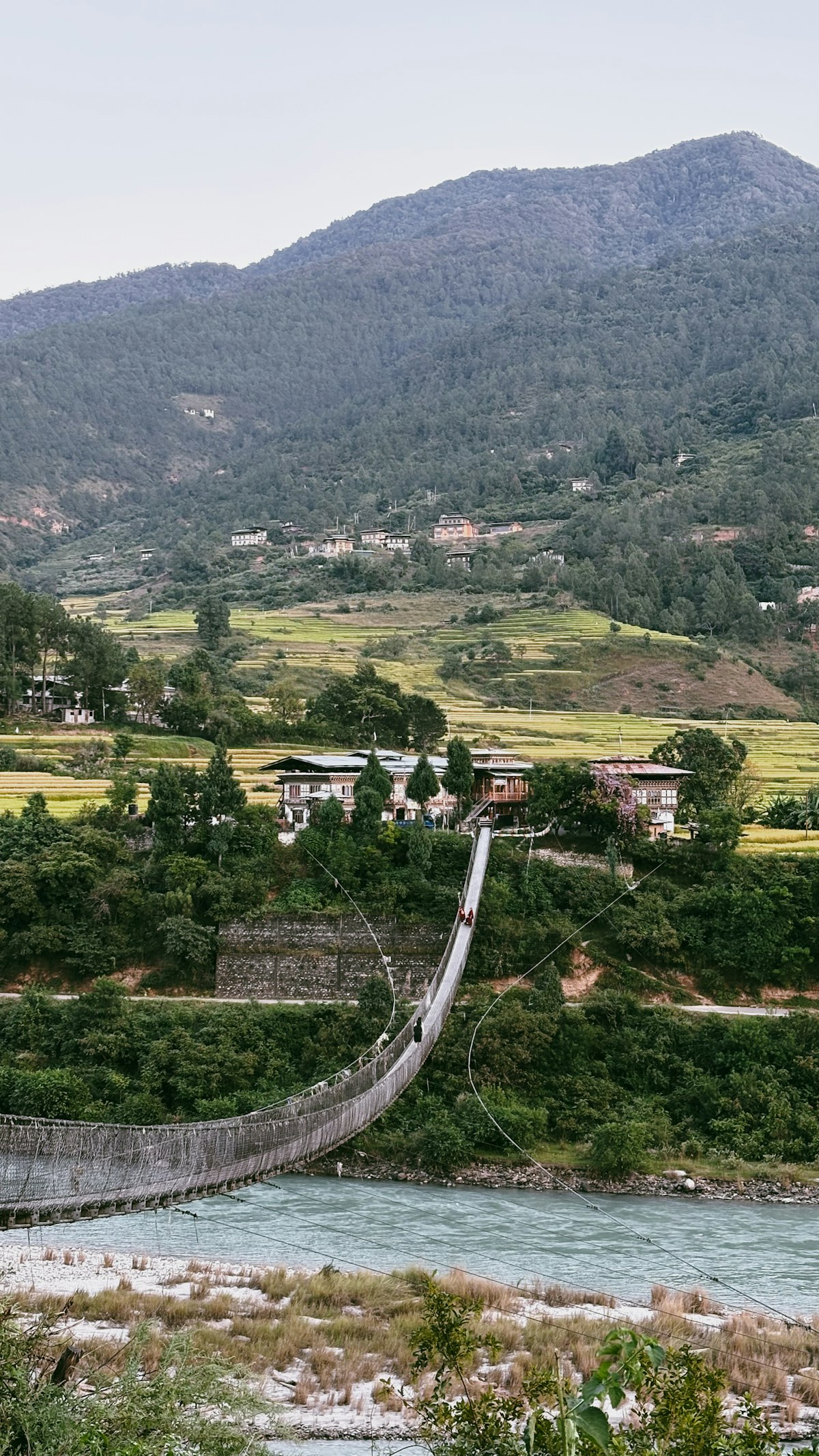
The descent from Badrinath is long but visually rewarding. You will pass all five panch-prayags (sacred confluences) on the way back: Vishnuprayag, Nandprayag, Karnaprayag, Rudraprayag, and finally Devprayag where the Alaknanda and Bhagirathi merge to become the Ganga proper. Pause at Devprayag for the obligatory photograph from the suspension bridge. Reach Haridwar and Ganga Harmony by 7–8 p.m., ready for a hot shower, a real meal, and a deep sleep before your flight home.
Distances and driving times at a glance
| Day | Route | Distance | Drive Time |
|---|---|---|---|
| 1 | Haridwar → Barkot | 210 km | ~7 hr |
| 2 | Barkot → Janki Chatti → Yamunotri → Uttarkashi | 150 km + 12 km trek | ~9 hr |
| 3 | Uttarkashi → Gangotri → Uttarkashi | 200 km | ~9 hr |
| 4 | Uttarkashi → Guptkashi | 220 km | ~9 hr |
| 5 | Guptkashi → Kedarnath → Guptkashi | Heli or 32 km trek | 3 hr (heli) / 14 hr (trek) |
| 6 | Guptkashi → Badrinath → Mana → Badrinath | 190 km | ~7 hr |
| 7 | Badrinath → Rudraprayag → Haridwar | 320 km | ~10 hr |
Packing must-haves for a 7-day yatra
- Layered clothing: Haridwar will be 25–30 °C in May. Kedarnath and Badrinath can drop to 2 °C overnight, even in summer. Pack thermals, a fleece, and a windproof outer.
- Sturdy walking shoes: non-negotiable for Yamunotri and Kedarnath. Break them in at home first.
- Personal medication kit: Diamox for altitude (consult your doctor), motion-sickness tablets, paracetamol, ORS sachets, basic first aid.
- Yatra registration printouts: save QR codes offline. Mobile network drops between Uttarkashi and Badrinath.
- Power bank, torch, and reusable water bottle.
- Light backpack for the Kedarnath trek — keep your main luggage in the car at Guptkashi.
Why end your yatra back at Ganga Harmony
Most pilgrims return to Haridwar exhausted, dehydrated, and emotionally full. Trying to fly out on the same evening is a mistake — flights from Dehradun are often delayed, and you are too tired to handle disruption. Spending Day 7’s overnight at our 3BHK homestay near Har Ki Pauri gives you a quiet space to decompress, do laundry, eat a proper home-cooked meal, and reflect on the journey before heading home the next day.
How Ganga Harmony supports your 7-day yatra
We have hosted Char Dham pilgrims for years and built the homestay around their actual needs: spacious bedrooms for groups of 6–8, a fully equipped kitchen for satvik meals, private parking for your yatra vehicle, and customised travel assistance — cab bookings, helicopter tickets, and end-to-end itinerary support. Most of our guests stay one night before the yatra and one night after, and many of them write to tell us the bookend nights at Ganga Harmony are what made the trip feel complete.
If you are still mapping out the broader picture, our overview pages on Char Dham Yatra planning and Haridwar and Rishikesh travel are good companions to this day-by-day plan.
Book Your Stay at Ganga Harmony
Your 3BHK home-away-from-home in Haridwar. Minutes from the Ganga ghats. The smartest place to begin and end your Char Dham Yatra.
Visit gangaharmony.com →