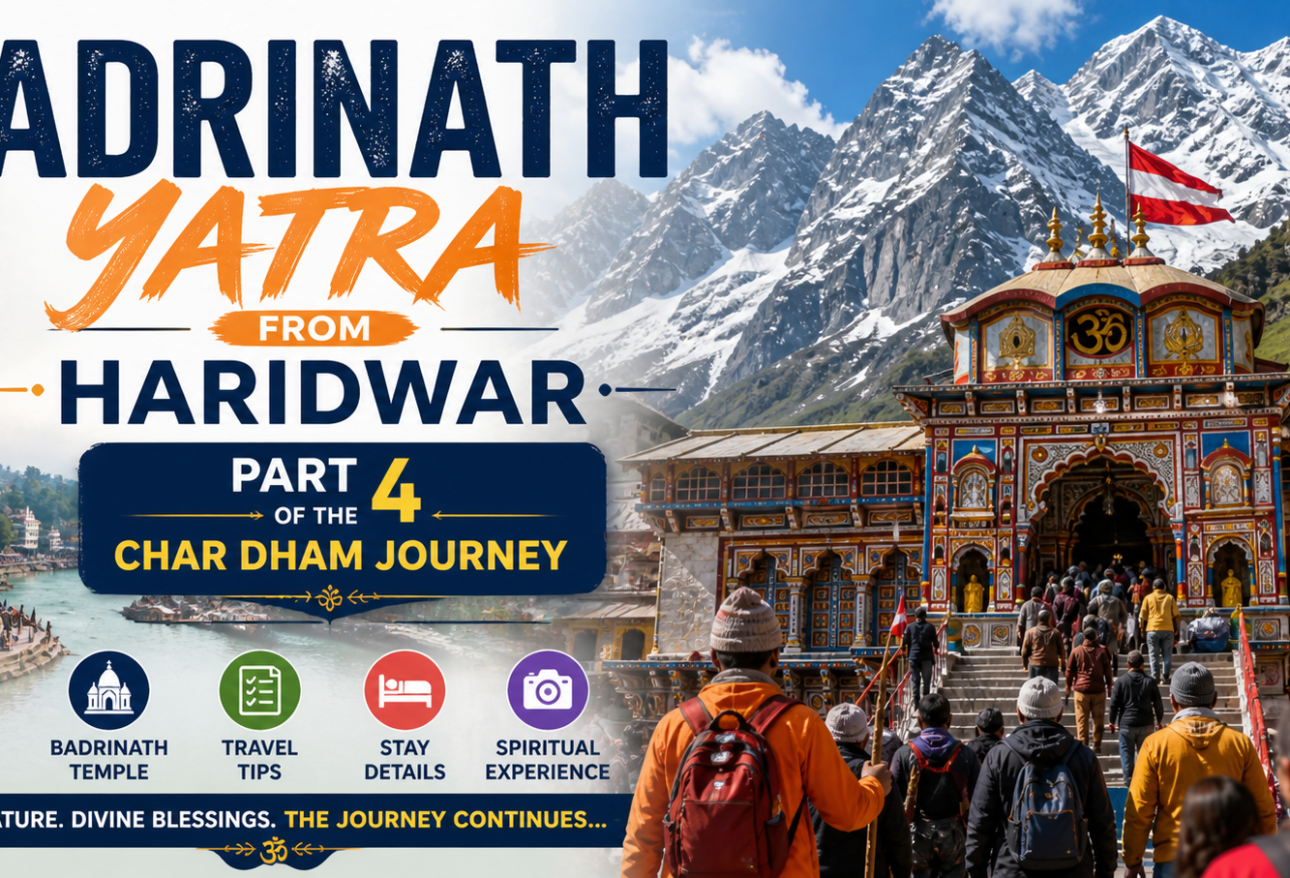
Badrinath Yatra from Haridwar — Part 4 of the Char Dham Journey
The fourth and final dham. From the steaming bathing tank of Tapt Kund to the last village before Tibet, Badrinath is where the Char Dham circuit reaches its quiet, breathless conclusion at 3,300 metres.
If the Yamunotri yatra teaches you to climb, Gangotri teaches you to drift along a sacred river, and Kedarnath teaches you to surrender to weather and wind, then Badrinath is the dham that asks you to simply arrive — and to sit. The temple is older than memory, the air is thinner than you expect, and the mountain that towers behind the shrine is named for Lord Vishnu himself: Neelkanth, the blue-throated guardian. This guide walks you through the route from Haridwar, the rituals at Tapt Kund and inside the sanctum, the side-trip to Mana village, and how to make Ganga Harmony your soft landing both before and after the climb.
1. The Road to Badrinath from Haridwar
Badrinath is the longest of the four drives, and it is the one that rewards patience most. From Haridwar the road covers roughly 320 kilometres and ten to eleven hours of mountain driving — and that is on a clear day, before traffic at the Panch Prayag confluences and the construction along the Char Dham All-Weather Road throw in their delays. Most pilgrims break the journey at Joshimath; some go further and split it across Pipalkoti or Chamoli. Almost no one drives it in a single push.
The classical route is unforgettable: Haridwar → Rishikesh → Devprayag → Rudraprayag → Karnaprayag → Chamoli → Joshimath → Vishnuprayag → Badrinath. Five sacred confluences (Panch Prayag) where one tributary or another joins the Alaknanda mark the rhythm of the drive — Devprayag (where the Bhagirathi and Alaknanda become the Ganga), Rudraprayag (Mandakini meets Alaknanda), Karnaprayag (Pindar meets Alaknanda), Nandprayag, and Vishnuprayag just before Badrinath itself, where the Dhauliganga merges in. Pause at one or two of them. Stand on the bridge for ten minutes. The whole geography of the Garhwal Himalaya makes more sense after that.
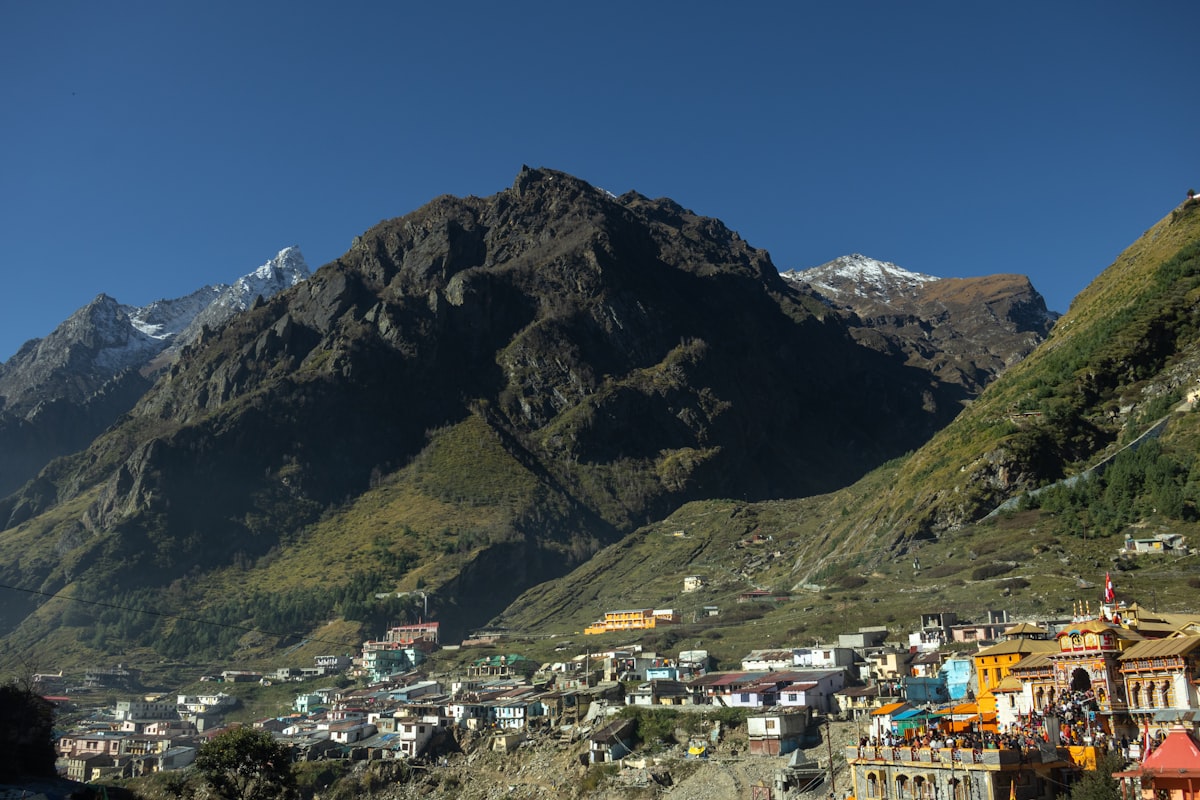
Past Joshimath the drive narrows and steepens. The army convoys here are reminders that you are now travelling toward the Indo-Tibetan frontier. The final stretch winds along the Alaknanda gorge and emerges into a wide, high, treeless valley — and there, suddenly, sits Badrinath: a small painted town, a brightly coloured temple, a turquoise river, and a wall of snow.
2. Arriving at the Temple — History & Architecture
The Badrinath temple, also called Badri Vishal or Badrinarayan, is one of the 108 Divya Desams sacred to Vaishnavas and one of the four cardinal dhams of India re-established by Adi Shankaracharya in the 8th century. Legend places the shrine far older still: Lord Vishnu is said to have meditated here under a wild berry tree (badri) while Goddess Lakshmi sheltered him from the snow by transforming herself into the tree — hence the name.
The temple is unusually small for its fame. A bright, almost cheerful façade in saffron, yellow and white rises only fifteen metres above a stone courtyard; a small conical roof tipped with gold sits over the sanctum. Inside, the deity is a black saligram-stone image of Vishnu in his meditative form, flanked by Nara-Narayana, Kuber, Garuda and other companions. The sanctum is dim, the chants of the Rawal — the head priest, traditionally a Namboodiri Brahmin from Kerala in keeping with Shankaracharya’s tradition — soft and continuous.
The temple is open only six months of the year, from late April or early May (Akshaya Tritiya) to the closing ceremony in mid-November (around Vijayadashami). When the doors close for winter, an oil lamp called the Akhand Jyoti is lit inside the sanctum, and the temple is left untouched until spring. Pilgrims who come on the opening or closing day witness one of the most photographed ceremonies in Indian Hinduism.
3. Tapt Kund — the Ritual Hot Spring
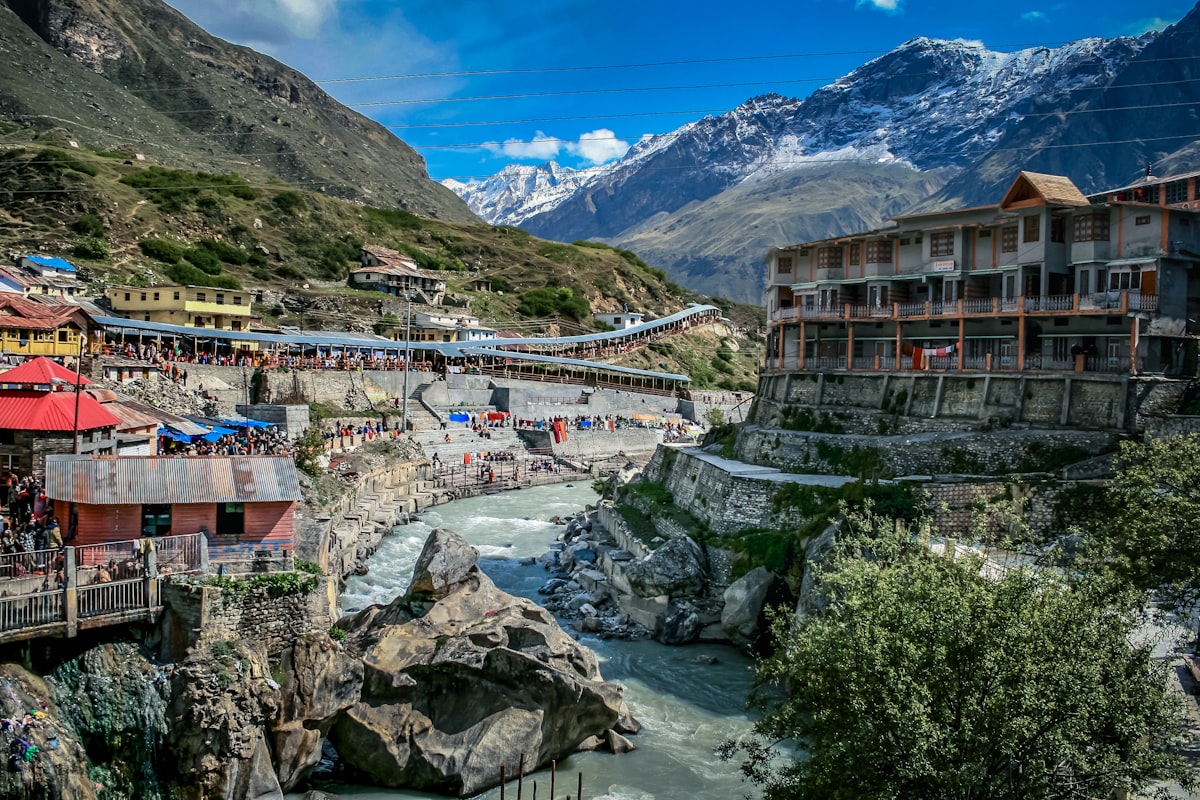
Below the temple, on the bank of the Alaknanda, a small enclosed bathing tank steams faintly even on the coldest morning. This is Tapt Kund — a natural sulphur hot spring that flows out of the rock at roughly 45°C, year round, regardless of how much snow lies on the slopes above. By tradition, pilgrims bathe in the kund before entering the temple. There are separate enclosures for men and women, and the water is genuinely hot — it is wise to ease in slowly, especially if you have come straight from a long mountain drive.
The contrast is part of the magic. Outside the kund the air is thin and cold; inside, you are submerged in mineral-rich warmth that the local belief says washes away both fatigue and accumulated karma from the long Char Dham road. A short way downstream are smaller springs — Surya Kund and Narad Kund — each with its own legend. Pilgrims often dip in Tapt Kund, change quickly, and walk straight up the small flight of steps to the temple courtyard for darshan.
4. Mana Village — India’s Last Village Before Tibet
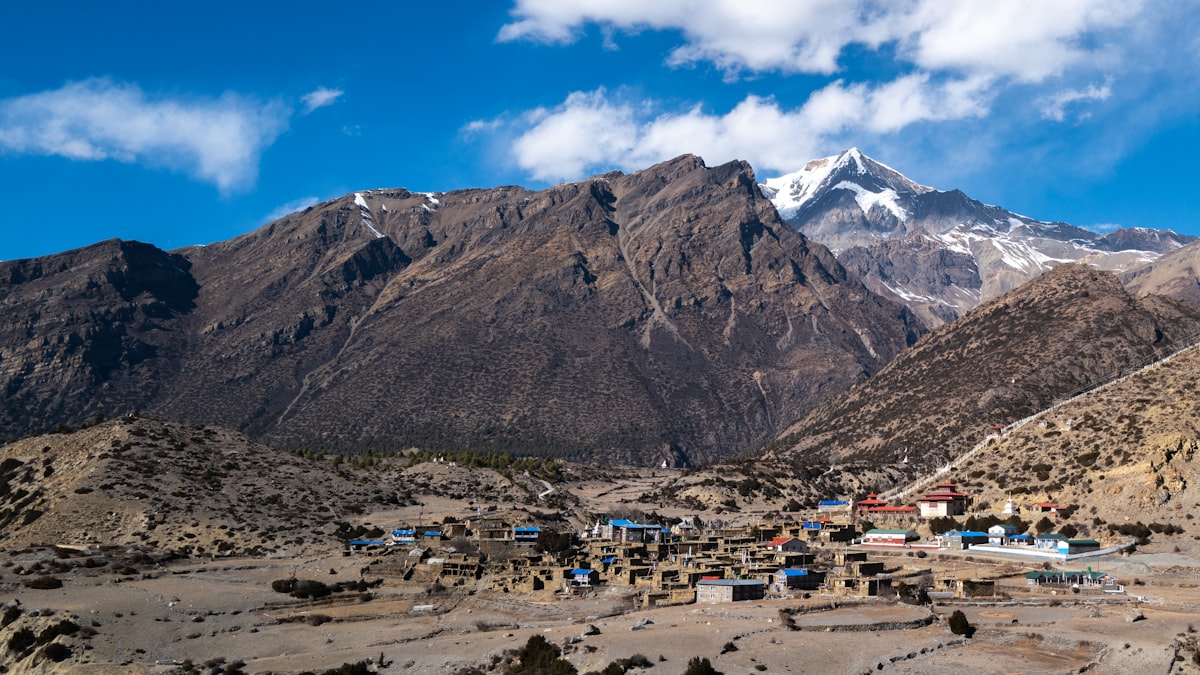
Three kilometres beyond Badrinath, the road forks once more and ends at Mana. Until recently Mana was officially marked as “India’s Last Village”; since 2022 the government has reframed it as the country’s first village from the border, and the new sign at the entrance reads accordingly. Either way, the experience is the same: stone houses with low slate roofs, prayer flags strung between juniper bushes, women weaving carpets and pashmina shawls in courtyards, and a thin, blue river — the Saraswati — bursting out of a rock face at the edge of the village.
Mana is inhabited by the Bhotia community, who historically traded with Tibet across the high Mana Pass and now run small woollen workshops and seasonal homestays. The village is open to pilgrims for the same six months as the temple. Walking through it takes roughly an hour, longer if you stop for tea in one of the cafés that proudly call themselves “the last chai shop in India” or “the last general store in India” — names that have become a small cottage industry of their own.
From Mana you can take short, gentle walks to several mythic spots: Bhim Pul, a natural rock bridge across the Saraswati that the Pandavas are said to have laid down on their final pilgrimage to the Himalayas; Vasudhara Falls, an hour’s hike further up; and the cave shrines at the village edge.
5. Vyas Gufa, Ganesh Gufa & the Saraswati Source
At the upper edge of Mana sit two small rock caves separated by a steep path of stone steps. Vyas Gufa, the larger of the two, is where the sage Veda Vyasa is believed to have dictated the Mahabharata to his scribe; Ganesh Gufa, just below, is where Lord Ganesha — that scribe — sat and wrote it down. The interior of Vyas Gufa has a strikingly layered ceiling, almost like the stacked pages of a manuscript; the priests inside tell the story patiently to anyone who pauses long enough.
A few metres further on, the Saraswati river crashes out of the mountainside in a single roaring jet of glacial water. By tradition this is the source of the mythical Saraswati that, downstream, is said to flow underground and finally meet the Ganga and Yamuna at Prayagraj. Whether one reads the story as geology or as scripture, standing within arm’s length of that white torrent is one of the most viscerally moving moments of the entire Char Dham circuit.
From the Saraswati source, fit pilgrims continue another five kilometres to Vasudhara Falls, a 400-foot ribbon of water where, legend says, the spray will only touch the truly virtuous. Allow three hours up and back, and don’t attempt it in monsoon — the trail is loose scree.
6. Altitude, Weather & What to Pack
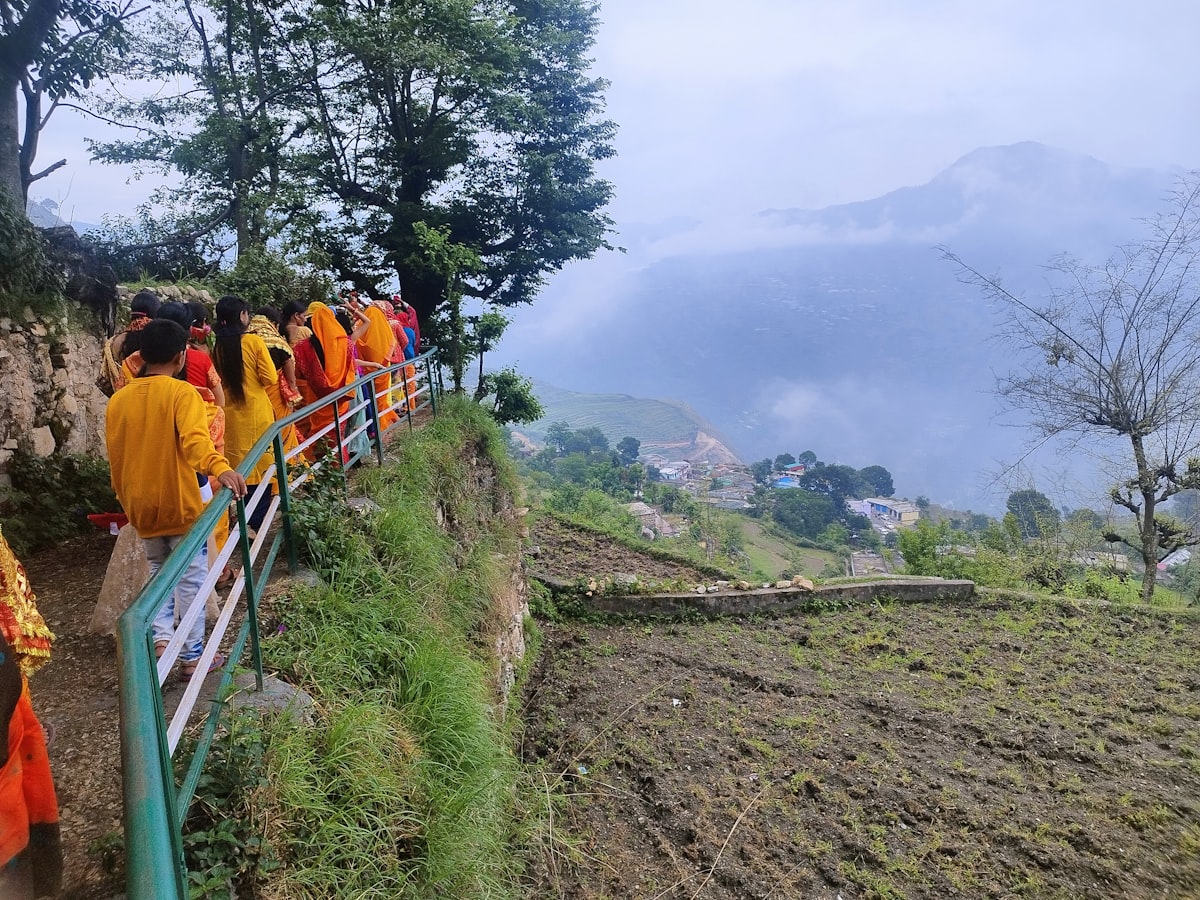
Badrinath sits at 3,300 metres (10,827 ft). That is high enough that the first night often brings mild headaches, broken sleep and a faintly racing pulse — classic markers of acute mountain sickness in its gentlest form. Most pilgrims acclimatise within 24 hours; a few, especially those who have driven straight up from the plains in two days, do not. The simplest precaution is to break the journey at Joshimath (1,875 m) for a night and sleep there before the final climb.
Weather windows matter. The temple opens between late April and early May; May to June is busy and clear. Monsoon (July–mid September) brings landslides on the road from Joshimath — never travel without checking BRO notifications. Late September and October are the most photogenic weeks, with sharp light and the first dustings of snow on Neelkanth. By early November the temple closes and the entire town empties. Even in summer the night temperature drops to 2–5°C; in October it can hover near freezing.
- Layered clothing — thermal base, fleece, windproof shell.
- Woollen cap, gloves, thick socks (yes, even in May).
- Trekking shoes with grip — Mana, the kund stairs, and the path to Vasudhara are all stone.
- Quick-dry towel and a small bag for wet clothes after Tapt Kund.
- A small bottle of glucose or ORS sachets for the altitude.
- Cash — ATMs in Badrinath town are limited and frequently offline.
- A photocopy of your ID; e-pass / Yatra registration printout.
Phone connectivity is patchy. BSNL and Jio work in Badrinath town; almost nothing works in Mana or beyond. Tell family back home you’ll be off-grid for a day, and treat it as a feature rather than a bug.
7. Completing the Char Dham — Rest & Reflect at Ganga Harmony
Most pilgrims drive back the way they came: Badrinath → Joshimath → Chamoli → Rudraprayag → Devprayag → Rishikesh → Haridwar. The descent feels different. Your lungs reopen at every prayag; the scale of what you have just done — four dhams, eight or ten driving days, several thousand metres of altitude — settles in slowly. By the time you reach the plains, you are quieter than you started.
This is the moment when a real bed and a real kitchen matter. Our 3BHK apartment at Ganga Harmony in Haridwar is laid out exactly for this homecoming: a full kitchen for simple post-yatra meals, three private bedrooms so a family can finally split out and sleep, hot showers without the sulphur smell, and a balcony where the Ganga is close enough to hear in the morning. We can arrange a ride from the Rishikesh ISBT or Haridwar railway station, store luggage if you arrive before check-in, and brew the first cup of chai for whoever is staring at the floor wondering whether it really happened.
If you are still in the planning stage and want a single page that ties all four legs together, the Char Dham from Haridwar overview stitches Yamunotri, Gangotri, Kedarnath and Badrinath into one practical itinerary. And if you’d like us to hold a date for you on either side of the yatra — pre-yatra rest, post-yatra recovery, or both — please get in touch; we keep a small block of dates open through the season specifically for Char Dham guests.
Four dhams done. The road brought you here, the mountains held you, and the river will see you home.
|| Jai Badri Vishal ||